









 Share
Share






Ten years ago, when Kendrick Lamar Duckworth released his third studio album, To Pimp a Butterfly, he most likely wasn’t considering my thoughts on the matter. I fully understand that Kendrick isn’t exactly focused on making his music accessible to middle-class white dudes from New England, like me. Growing up in Compton and being exposed to the horrors of gang violence at an early age, Kendrick took to rapping to express his trauma through music and poetry. Over the course of 22 years in the game, he’s used his platform to speak out about issues that plague Black culture, like systemic racism, police brutality, and organized crime.
Few rap albums have been as impactful in recent years as To Pimp a Butterfly – or TPaB, for short – which was inspired by a trip to South Africa in which Kendrick felt drawn to the environment and its people, as well as the oppression experienced by folks like Nelson Mandela. What began as emotion transformed into action and thus, To Pimp a Butterfly was born. Now, going back to my initial claim, I’m fully aware that Kendrick has a massive number of white fans who can relate to his bars in their own ways. I’ve never been opposed to giving his music a chance, I just haven’t been exposed to much Kendrick over the years.
This brings us to March 15, 2025, perhaps the day you are reading this very article. With all the Kendrick hype following the Drake feud and the Super Bowl Halftime Show (if you have no frame of reference for either of these events, I’ll link some external assistance), I thought it might be fun to dive headfirst into Kendrick’s most celebrated piece of work. Having only ever heard a handful of his tracks – “Humble,” “Not Like Us,” and the Black Panther soundtrack seem to be all I can recall – I’m genuinely excited to don these headphones and experience just why TPaB is considered a “dazzling masterpiece” (according to The Daily Telegraph’s Neil McCormick).
This one’s for you, Emmett.
From the first beat of “Wesley’s Theory,” I’m sucked into a funk infusion that had me wondering why it took me so damn long to give this a shot. I can see how this album is heavily inspired by jazz and soul singers of the ’70s and ’80s, especially Nile Rogers and James Brown. Considering Kendrick included artists like George Clinton in the recording process, it’s clear he wanted to emulate the vibe as true to form as possible. Even so, TPaB successfully brings that classic funk feel into a fresh future, going so far as to sample tracks from not only rap legends like Tupac, but even The Jackson Five (I heard that use of “I Want You Back” on “Complexion;” one of the greatest songs of all time isn’t going to slip by me that easily, even if it is using minor chords).
On the topic of Tupac, it took me some time to realize just how much of a love letter this album is to him. Having not grown up with much Tupac in my life, I wasn’t catching the samples or the references or the fact that he tremendously impacted the views and beliefs of Mr. Kendrick Lamar. From top to bottom, To Pimp a Butterfly is coated with a message of not only self-love, but also loving your fellow man. This was probably the most profound epiphany I had while listening to these songs, that Kendrick doesn’t exactly speak on the world’s treatment of black people so much as he speaks of community.

Image Credit: IMDb
Much like Tupac, Kendrick started on the ground floor with this movement, using his music to bring Black people together against the common enemy that is racism. You can hear it in the words of tracks like “Institutionalized,” “Hood Politics,” and especially “The Blacker The Berry” (So why did I weep when Trayvon Martin was in the street, When gang-banging make me kill a n—blacker than me?). Kendrick is clearly frustrated with the infighting that not only affects communities and the children within them, but also distracts people from the bigger picture: systemic racism.
I think it’s also intriguing to look at TPaB through a lens of knowing Kendrick’s work since this album, considering back in 2015 – a pre-Trump America with a black president – there were many issues within the culture still unaddressed. Looking at his career in 2025, in which he has not only spoken out against police brutality and racism for years but also headlined the biggest sporting event in America, it’s safe to say Kendrick has made quite the impact on the zeitgeist, and the issues addressed within this album. All this being said, however, the music still holds up as a spectacular call to action and a tracklist of expertly crafted bangers.

Image Credit: CheatSheet.com
As stated earlier, this album goes hard right out of the gate, with an intense burst of funk and soul, complete with saxophones and other jazzy accompaniments. This was all quite unexpected, but welcome, nonetheless. Being a huge fan of Gorillaz, I gravitated to these vibes, and with every track, it seemed to get better. “King Kunta” was an instant standout, providing a catchy, upbeat energy that I wished I’d heard sooner. I knew this album would include a few songs that had me thinking, “Where has this been for a whole decade?!” “King Kunta” was certainly one of these, as was “i,” but I love that one for even more reasons I’ll get to in a bit. Rest assured, it wasn’t hard to see why Kendrick’s sound took the world by storm all those years ago.
Unfortunately, not all songs can be jovial and upbeat, but Kendrick tackles even this challenge head-on. Perhaps the darkest and most poignant track, “u” serves in direct contrast to the aforementioned “i,” swapping the optimistic messaging for one of struggle and self-loathing. You can tell there’s a real battle going on within Kendrick on this one, and according to interviews, that darkness was apparent in the studio as well. Kendrick’s engineer, MixedByAli talked about the recording of “u” in The Oral History of Kendrick Lamar’s “To Pimp a Butterfly,” stating “[The] session for “u” was very uncomfortable… super emotional… I never asked what got into him that day.” The frustration is palpable in Kendrick’s vocals, and that adds to the melancholy tone.
Pardon me for getting sidetracked, but I’ve always struggled to see why some rappers shift their voices during their songs. Being a fan of Kanye until… you know… I have seen him do it on some songs before, and some modern-day raps that make it big on the pop charts even do it. If you’re confused by what I mean, I’ll point you to what Kendrick does in the chorus of “u.” When reciting the lines “Loving you is complicated,” he shifts the tone up on the end of “complicat-ed!” and normally I would hear this in passing and think, “well, that’s just a silly song.” But I wanted to touch upon this because TPaB got me to respect this artistic choice for the very first time. Especially in “u,” Kendrick’s usage of the tone fluctuation connects to how chaotic the situation at hand feels. His emotion is better conveyed through this wild flailing of the chorus and helps relate to said dysfunction. I know it’s a very simple concept to go into detail on, but I wanted to give props to yet another aspect of this album that changed how I view the medium.

Image Credit: Dissect Podcast
I mentioned Kanye there for a moment, and I’m already wishing I hadn’t. So perhaps I’ll spin this to another rapper that I couldn’t stop thinking of while listening to TPaB: Logic. I know, he’s a bit much these days, and yes, his songs can be very cheesy. But I think it would be remiss to leave him out of the discussion considering he’s arguably the rapper I follow the closest these days… and he is heavily influenced by Kendrick. I could tell almost instantly how Logic has drawn from not only the instrumentations K.Dot uses (have you heard those saxophones?!) but also the way the man raps! Their flows are very similar, and I think that honestly helped me connect with Kendrick more from the get-go. I appreciate how in his rambling it never feels nonsensical. Kendrick raps so poetically that every word feels expertly crafted, even if it’s being shouted at you rapid-fire. He truly is one of the best in the game.
Something that will stick with me about To Pimp a Butterfly is the tonal whiplash between upbeat, optimistic songs and darker, poignant ones. I think Kendrick intended to do this, paralleling the experience to life’s own roller coaster of emotions. Tracks like “i” and “Alright” bring a sense of hope to this album, with the latter being a particular standout. Looking into the release history of To Pimp a Butterfly, it seems “i” was the lead single, and “Alright” – produced by the inimitable Pharell Williams – earned Kendrick several Grammy awards. I think if I had given it a chance earlier, “Alright” would’ve been a favorite of mine for the last decade. It has that aforementioned Logic feel, a catchy beat, and a hopeful message – what’s not to like about that? “i,” on the other hand, feels like a love letter to loving each other, and I absolutely adore how the album includes a live version rather than the studio recording. Don’t get me wrong, the studio version – which I checked out after the fact – does go pretty hard. However, the fact that the album version of “i” literally breaks down in the middle to allow Kendrick to get up and preach a cappella? I mean, come on, was that off the dome? I was left speechless by the end of it, truly. That song… I’ll get back to it.
Video Credit: Kendrick Lamar
Shifting focus back to the more thought-provoking tunes on offer, I must give a shoutout to “The Blacker The Berry.” This being the second single from the album, it garnered some contempt from conservative audiences when Kendrick performed it at the Grammy Awards. Being a song about racism and police brutality, I’m sure it resonated strongly with the BLM crowd that was building at the time of TPaB’s release. It’s a song that feels fed-up and tired, yet structured and focused on the task at hand. I appreciate how it ends rather abruptly and leaves you with nearly a minute of jazzy outro to contemplate what you’ve just heard. Furthermore, I tend to dislike the Jamaican style of rap – used rather frequently by Gorillaz – but here, I think it fits. Part of me doesn’t like how this track makes me feel, and I think that’s the proper response here. So, reflect on that, conservatives.
To Pimp a Butterfly’s greatest gift to me – and in 2015, the world – is the genius of Kendrick’s storytelling. The man knows how to craft a narrative and deliver a message to the public. Whether it be “These Walls,” which tells a story of revenge in the wake of his friend’s untimely murder, or “How Much a Dollar Cost,” in which a man neglects a homeless beggar only to find they’ve turned down God Himself, these tracks provide tales that stick with you. When Kendrick goes home to Compton on “Momma,” you feel his wariness through the slightly off beats in the background. I can barely describe how good “Hood Politics” is because nobody can put that message together better than Kendrick. You just get this feeling that he knows what he has to do, and he’ll stop at nothing to do it. Even speaking on “These Walls,” Kendrick once said, “It’s a record that I always wanted to make but didn’t know how to make. (Genius)” But in the end, he made it happen, and in doing so, he changed the entire game.

Image Credit: Junkee
I must admit, in searching for the lyrics of To Pimp a Butterfly, I spoiled myself on its profound conclusion. Yet, discovering the fact that TPaB is a concept album in disguise only heightened my experience as I went along. Listening to Kendrick recite his poem to Tupac every few songs – adding in lines that coincide with the music at hand – became damn near hypnotic. Amidst this trance-like state, the interludes that not only serve as a moment to reflect on the chaos but also confront Kendrick’s demons, whether they be the scorned women in his life or the idea of Lucifer himself. These abstract concepts hidden amidst the album’s tracks make To Pimp a Butterfly feel like a message wrapped in a mystery, and the only way to unravel it is to keep listening.
The full poem and subsequent meeting with Tupac on “Mortal Man” serve as the perfect finale to this musical journey. Splicing in audio from an interview dated two weeks before Tupac’s assassination, Kendrick is able to “ask questions” to the legend who helped shape his life and career. It’s introspective and surreal to hear just how similar their goals are: reaching the black community with their music, sharing the culture by reflecting on their roots, and spreading the essence of love and prosperity.
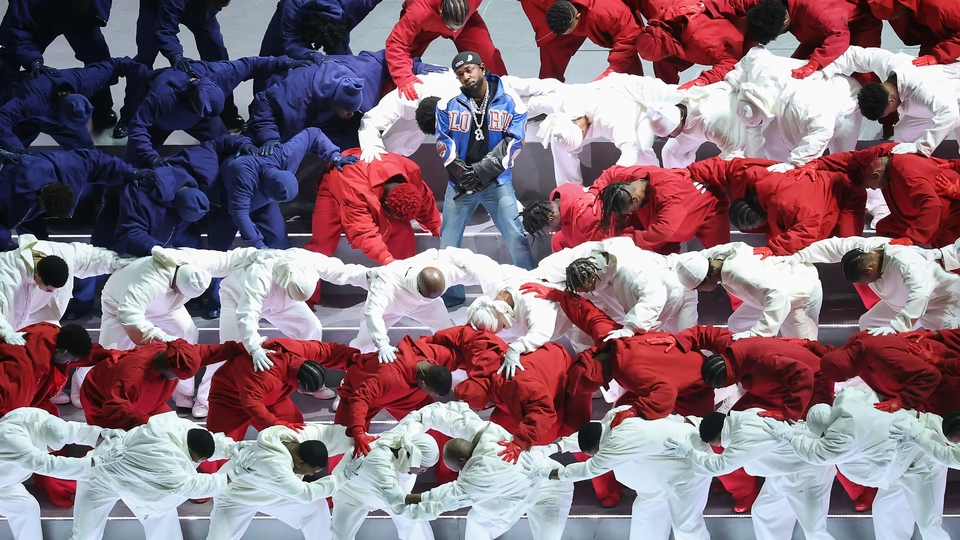
Image Credit: The Atlantic
As I put down the album midway through to take a shower, I found myself switching to my Lorde playlist, an artist whose music I found deep comfort in throughout my high school years. Hitting the scene in 2013 when I was 16, Lorde’s three subsequent albums have been there for me at various stages of growth, sheltering me with her poetic, relatable lyrics and unique backing instrumentation. Standing in the shower, being met with three of her songs, each from a different era, if you will, it hit me that while I was using this music to get me through some of the toughest years of my life… many others were doing the same with To Pimp a Butterfly.
If you’ve never heard this album yourself, simply try to picture the world in 2015 and insert the descriptions you’ve been reading thus far. Can you imagine an America on the brink of the unknown? Just two months before TPaB released, Hamilton debuted on Broadway, a musical that took the world by storm, infused with rap – in both lyricism and references – to tell the story of this country’s birth. Not long after TPaB released, Black Lives Matter protests erupted nationwide to counteract the looming threat of a white nationalist government. The list goes on, and as Kendrick rose to fame, his music prevailed through countless protests, obstructive policies, inflammatory presidencies, a pandemic, an extremely public feud, and the goddamn Super Bowl Halftime Show. This Good Kid got out of the M.A.A.D City and became a household name.
I think it’s best to leave this review on a high note, reflecting on some words Tupac shares in the “Mortal Man” interview. When asked how long he thinks it will take for black men to give up the fight and accept the broken system, Pac responds, “In this country a black man only have like 5 years we can exhibit maximum strength… Cause once you turn 30 it’s like they take the heart and soul… out of a black man in this country.” As soon as I heard that, you know I had to check; Kendrick Lamar is 37 years old, and he’s fighting harder than he ever has. Better still, he’s making bigger changes to the zeitgeist than he ever has; the dude’s more relevant and prolific than he’s ever been!
I look back now, as I’m writing this conclusion after a full day of listening, writing, and commiserating, and I can thoroughly say with my chest that the hype was worth it. To Pimp a Butterfly is more than just some excellent music – though it definitely is that. This album serves as the introduction to a legend; the introduction to a movement at an extremely vital time in this culture. Kendrick gave the world TPaB when it needed a message like this, and I can only imagine what that must have felt like to be a part of it all as it unfolded. I said it at the start, but Kendrick Lamar may not have made this album for someone like me, and that’s okay. His goal is to empower the Black community, share the love and the pride, and bring people together. I guess his greatest trick was being able to bring anyone into the fold, as To Pimp a Butterfly has resonated with so many in the decade since, regardless of race, gender, or creed. Kendrick asks in the final track, “When shit hit the fan, is you still a fan?” I think it’s safe to say that ten years later, shit is hitting the fan on a daily basis… and this album still made a fan out of me.
Final Score:

Next Post











Pingback: Friendship with Switch Ended, Now ROG Ally X is My Best Friend | The Player's Club Podcast Ep. 152 - VGU.TV