









 Share
Share






In this landscape of diverse video game genres, few seem to be attacked as often as the “walking simulator.” An extremely broad, vague description of any game with minimal combat and a heavy reliance on environmental storytelling, the “walking sim” genre has more opponents than defenders these days, and today I will do my best to shut these voices out. This wasn’t planned as a “defending walking simulators” piece. In fact, I was hoping to do two separate reviews of Don’t Nod’s Aphelion and Mixtape from Beethoven & Dinosaur, two terribly controversial titles of the last few weeks that I thoroughly enjoyed. However, it has become increasingly clear to me that games like this, while exciting and satisfying to play, tend to fall to the wayside and be met with extreme criticism due to their nature of gameplay and storytelling. It’s a genuine shame, and it’s an issue I hope I can help clear up through this discussion.
It’s no secret I am a huge indie game fanatic. I’d wager over 60% of what I play in a year – between older games and new – are indies. I find them easily accessible, with shorter playtimes (on average) and the lack of a “AAA feel” helps me approach them with less bias and see the passion through the production. Indies always exude a “quality over quantity” kind of presence, even when the runtimes are longer – looking at you, Expedition 33. But this love of indie gaming shaped the niche to which I gravitate: narrative-driven experiences, where the choices you make matter and the mystery unfolds around you. This isn’t to say I don’t enjoy a little shooty-shooty bang-bang here and there. Hell, my love of video game storytelling began with larger AAA titles like Call of Duty: Black Ops and early Assassin’s Creed installments. What makes indies fascinating, though, is their ability to turn gameplay one is passionate about into a rich story that sticks with the player forever.

Genres of the indie space are extremely varied, and I would argue it is because of these games that AAA developers learn of emerging trends. Survival games wouldn’t be as big without Minecraft and Terraria; roguelikes owe their popularity to The Binding of Isaac and Spelunky; deckbuilders earned their time in the spotlight with big hits like Slay the Spire and Balatro. But as indie games kept coming and the rules of genre kept bending, we started to run out of words in some cases. Enter: the “walking simulator.” I’ll stop putting it in quotes going forward, but I want to make sure I’ve stressed my distaste for the term. Calling something a walking simulator has become commonplace for anything without action and – according to most users of the phrase – anything without substance. My biggest gripe out the gate is how offensive that is to all the pioneers that have come before. As much as a game like The Binding of Isaac started a movement in its own niche, the likes of Telltale games (The Walking Dead, The Wolf Among Us, etc.) and even Don’t Nod’s Life is Strange series really hold their own and deserve more than a catch-all term used to describe story-focused indie games.
Most would probably credit the earliest use of “walking sim” to games like Dear Esther in 2008 or even Fullbright’s Gone Home in 2013. The most ironic being the former, whose developer – The Chinese Room – worked on the second installment in one the most iconic survival horror franchises of the 2010’s: Amnesia. But who would call a game like Amnesia: A Machine for Pigs a walking simulator? Surely, its reputation as survival horror or even a puzzle game overshadows such a pitiful descriptor and thus earns it a spot above the rest. But at its core, Amnesia is just like those who get shot down by the crowd. No combat, a focus on environmental storytelling, random puzzle encounters, stealth segments… are we talking about Amnesia or Aphelion? Funny, I’ve only seen comments on Aphelion videos and forums calling it a “walking and climbing simulator,” yet I grew up with games like Amnesia and Soma and hey, they were beloved! Weird double standard, huh?
Now, I know I’m getting a little cranky here and I really want to keep this on track and not just go on rude tangents against the internet. I refuse to interact with a whole leg of the walking sim argument – no pun intended – in which people just yell about these games being “woke.” There’s a whole argument to be had about how bastardized the definition of the term has become, and how nobody wants to accept wokeness for what it is: being “aware of and actively attentive to important societal facts and issues.” I’m sorry Life is Strange, Aphelion, Mixtape, and Dustborn all have female protagonists and some of them mention queer topics. Actually, I’m not sorry at all. Grow up, Grandpa. But seriously, I would like to take a little bit and talk about two of these games and while I won’t do a massive deep-dive review of each like I’d intended, I will focus on why their “walking sim” qualities shouldn’t keep you from playing them.

Aphelion released back on April 28, launching on Game Pass and keeping my Xbox Series X and I occupied for, oh, about 7 hours. The game is rather short, but that does seem to be the theme of the day. Aphelion follows two astronauts, Ariane Montclair and Thomas Cross, as they crash land on a planet they were sent to explore. The crash separates the two, and as they set out to find each other in this desolate world, a mystery unravels about the planet’s history. The gameplay of Aphelion is its most intriguing quality. Ariane’s journey takes her across a barren, cavernous tundra where she scales mountains and swings from cliff to cliff. Her gameplay is very reminiscent of Uncharted with a little Jusant mixed in – a welcome callback to another Don’t Nod title. Peppered around Ariane’s levels are some stealth sequences, as well. These never felt particularly tense until the game’s final level, but they broke up the exploration with some close-quarters action, and I found it all flowed quite nicely.
The other half of Aphelion follows Thomas Cross as he is injured in the crash and subsequently cannot explore freely due to mobility issues and a damaged oxygen tank. Thomas’s perspective is a lot more puzzle-based, with the player having to find oxygen stations to hook up to and then plan the quickest route to the next. It adds a layer of tension to this “walking simulator” and while the oxygen tanks are placed in a linear fashion throughout the world, getting to them may require some skill between planning a path and navigating obstacles to reach the destination. Thomas also uncovers most of the story’s mystery, which plays out through audio logs, text logs, and a more labored approach to exploration than his counterpart. I really enjoyed these scenarios, as it brought me back to games like Fort Solis and Deliver Us the Moon, wandering around and letting the world tell a story. You know, the bread and butter of the walking sim.
The beauty of Aphelion is how it showcases so much more than walking and climbing. For someone with no desire to pick this game up, it gets dragged for its use of yellow paint, its black female protagonist, its short runtime, and the inability to throw a punch. But as someone who let this game into their life, Aphelion may end up as one of my favorite experiences of the year. I found its traversal mechanics engrossing and as I scaled enormous mountains I was blown away by the stunning lighting and particle effects. The character models look insanely detailed and realistic; the water and the shadows are just incredible. The story at hand is shocking and tragic and full of heart. It’s always so fascinating to me how a story this short (and rather cheap at only $40) can provide such a deep, thought-provoking experience that satisfies me more than some AAA titles ever have. Maybe it is a little janky at times with the movement and maybe the music wasn’t as memorable as I would’ve hoped, but everything else from the visuals to the acting to the story at hand earn Aphelion a 4/5 from me.


Wait, what was that about music? If you want music, look no further than Mixtape, the new walking simulator from Annapurna Interactive. I’m just kidding, calling Mixtape a walking sim isn’t even scratching the surface of what’s on offer here. See, back in the day we had games that defied all genres in the form of “minigame collections.” I’m talking about something like WarioWare or Rhythm Heaven. These games basically said, “what if Mario Party told a loose story and we made a game where the levels were just various little tasks?” It’s kind of brilliant. It was definitely fun. But then over time this concept evolved – thanks to indie developers – into a sort of… interactive film with gameplay elements. Two of the largest examples that come to mind are That Dragon, Cancer and What Remains of Edith Finch. Both games are immensely tragic in their own ways, and while I refuse to spoil either, I will say they both touch upon illness, death, and the enduring pain of those who live on. They’re some of the most beautiful stories in gaming, and they are not to be missed. From WarioWare to absolute misery, what a tonal shift this paragraph was!
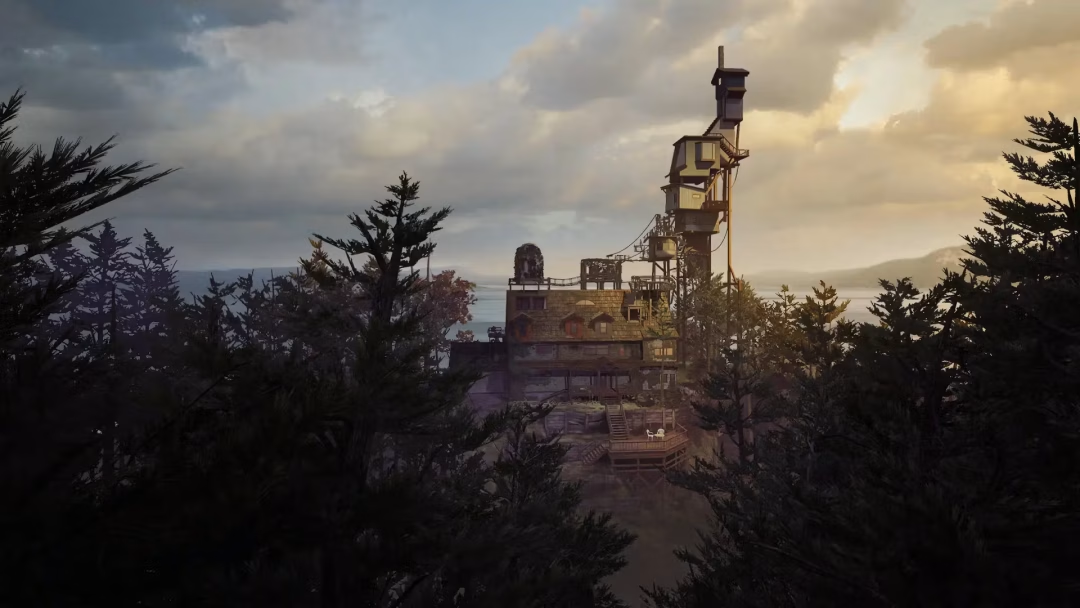
This leads me to a sentence I’ve been wanting to say for years: to call a game like What Remains of Edith Finch a “walking simulator” should be considered a hate crime. Edith Finch is an experience, and one that has deeply affected nearly everyone who has picked it up. It’s a mystery that is told through multiple perspectives, multiple lives, and multiple varied level designs. It’s a minigame collection, yes, and sort of an interactive film, in a way. It’s a passion project brought to life through the art of game making. It’s certainly not something you shut your mind off and relax with. That, in essence, is at the core of all walking sims – thought. These games are cerebral, they take your mind for a journey, and they grab hold of your emotions. Whether they’re an interactive memoir like That Dragon, Cancer or a means of storytelling through an alternate visual medium like Everyone’s Gone to the Rapture, these games have layers that go deeper than simply… simulating walking.

So, what’s the new hotness in terms of “interactive experience?” How do we keep building upon a style of entertainment that asks more than watching a film does, and pulls you right into the story at hand? Perhaps blending said experience with yet another medium that practically anyone on the planet can relate to. Enter: Mixtape, a musical adventure told across nearly 30 licensed, real-life songs from the 80s and 90s. If you haven’t been following the news closely this month, Mixtape has kind of set the gaming landscape on fire, what with its plethora of positive critic reviews amidst negative feedback from gamers in general. To call Mixtape “polarizing” would be a severe understatement, yet this backlash is easily thwarted when applied to the context of our current discussion.
Mixtape checks a lot of the typical boxes when describing the infamous “walking simulator:” a coming-of-age story, hints at queer representation, female protagonist, zero combat, some levels play themselves – the list goes on. Not to mention the entire game takes roughly three hours, with almost no replayability nor a way to stretch the length further. For all intents and purposes, Mixtape could be compared to a film, or as I described it earlier, an “interactive experience.” We could argue all day about how it doesn’t fulfill the “requirements” for what a “video game” is, but I’m only here to dispel the label of “walking simulator,” as well as the fact that it “doesn’t deserve praise.”
Call me a shill for coming-of-age media, but as someone raised on books like To Kill a Mockingbird and films like The Breakfast Club, it’s hard not to have a nostalgic fondness for the naivete of youth. As a coming-of-age experience, Mixtape delivers on all fronts, following a group of three teenagers as they rebel through their final summer together before life takes their futures in separate directions. Our main character, Stacey Rockford, plans the soundtrack to the summer – the titular Mixtape to our tale – and levels play out in the aforementioned “minigames” set to these tracks. Sometimes we may be TP-ing the principal’s house to “Zebra Crossing” by The Eye Gouge or soaring across a field to “Airwalker” by Bertrand Dolby. Every level tells its own short story, accompanied by vibrant colors and a fitting tune.

There’s a pretty excellent interview with the developers over at ScreenRant that I’d like to highlight, because as I’m talking about the passion of indie devs, nobody explains it better than they do. Game director Johnny Galvatron gave a wonderful quote that just solidifies the feeling of making a game like this, “Every person on the team, especially when it’s an indie team, is always at it. And every time I walk through the level I see new things and I see the team members who did it. … I see my friends there, constructed in the level, and they’ll be there forever. I think that’s a great feeling.” Having personally been to conventions like PAX East and seeing the immense dedication and zeal of these developers, I understand how seeing a labor of love like Mixtape come to fruition must be a feeling unlike any other.
So why, then, all the backlash? Well, aside from the obvious braindead “woke” criticisms, I think it’s just difficult for some to find a game like Mixtape instantly enthralling. I cannot fault them for having their preferences, but as I’ve said before, that doesn’t mean calling it downright bad is the right way to go, either. I think GameSpot described Mixtape’s style best as “a buffet of gameplay elements that come and go quickly, but are always exciting.” This is a game that – like Aphelion and other “walking sims” before it – you must let into your heart and let it take your emotions on a journey. Mixtape is rewarding, fun, and beautifully made, and as it left a tear rolling down my cheek, I knew it was worthy of a perfect 5/5 after all.

Before I let you go back to your lives of playing honestly whatever you want to play, I’d like to recap a little and go over the lessons I hope we’ve learned. I’m not going to claim I have a better name for these games than “walking simulator.” I have tried for many years now to think up a better genre descriptor, especially when games like Life is Strange feel completely different than Gone Home and Aphelion… yet the world looks at them with the same negative lens. I could go on and on about this, yelling on various podcasts and writing another huge opinion piece when the next Don’t Nod production arrives. Hell, there are more games like these that I’ve yet to touch this year! What do we call Directive 8020? Or Tides of Tomorrow? While we’re at it, why do we get to call Myst and The Witness puzzle games and not walking simulators when that’s exactly what they are? Hold on, some website put Death Stranding on a Top 10 Walking Simulators list?!
Do you see my point now? Calling a video game a walking simulator is essentially one of two things in 2026: either a game without enough action and combat to keep the average Fortnite player entertained, or a game that touches upon real-life issues like race and gender identity. Scratch that, a game that includes someone of a different race or gender identity. Even while writing these two qualifications, I thought of a third: a game that many struggle to “classify as a game,” whatever that means. The whole genre is twisted, and it’s for that reason that a whole side of the games industry is in shambles. Every time a game like Aphelion or Mixtape comes out, there will always be YouTube comments saying, “journalist game,” “somebody got paid,” and “the reason we can’t trust journos anymore to give us valid opinions.” There will always be trolls online, yes, but an overwhelming amount of people truly think anyone with a different opinion than you must have been paid off. Not to mention, the consistent hatred of internet commentors that refuse to allow any levity in games journalism. Heaven forbid a review not be the law of the land; heaven forbid a critic have a little fun with the content they make. This harkens back to a classic Cuphead scandal online from 2017, in which Dean Takahashi of GamesBeat posted himself failing at the game just as a fun showcase of the difficulty, and was met with nothing but vitriol. All this to say, perhaps we need to be a bit more open-minded, if not a bit kinder.
I disagree with games journalists’ reviews sometimes, but if a large majority give a game a near perfect score, chances are it’s a great game. I think Mixtape is nearly perfect, and I wasn’t paid a cent to believe that. Other VGU editors played it and loved it, because it is the type of game we enjoy. Look at our other opinions, we gave The Forgotten City GAME OF THE YEAR! The beauty of video games, and indie gaming especially, is that there is something for everyone out there. I feel so blessed to live in a world with games like Aphelion and Mixtape. They tell stories I want to hear and deliver it through accessible means that I enjoy. Shorter games are easier to play with my busy schedule and coming-of-age stories harken back to a time when I felt happiest. Some people need that sometimes, and they’re not wrong for enjoying it. I don’t exactly know how to end this, but I know I feel better having said my peace on what a walking simulator is to me. If we could just put a positive light on the name for once and realize these games do deserve a pedestal amongst the Doom’s and the Halo’s and even the Madden’s of the world, then maybe more people would give walking sims a chance.
Thank you for listening.





Self-proclaimed "Contrarian American." Lover of all things Broadway, Robert Kirkman, and Christopher Nolan. Most likely playing some narrative-heavy adventure game.






What do you think?
It is nice to know your opinion. Leave a comment.